Written by Sid Joshi
Founder, WorthCheck.in
NPS vs EPF vs PPF: Which is Best for Retirement in 2026?
You have EPF deducted from salary. Your CA says open PPF. Your friend swears by NPS tax benefits. Should you do all three? Or focus on one? I'll show you exactly how each works and the optimal strategy for different income levels.
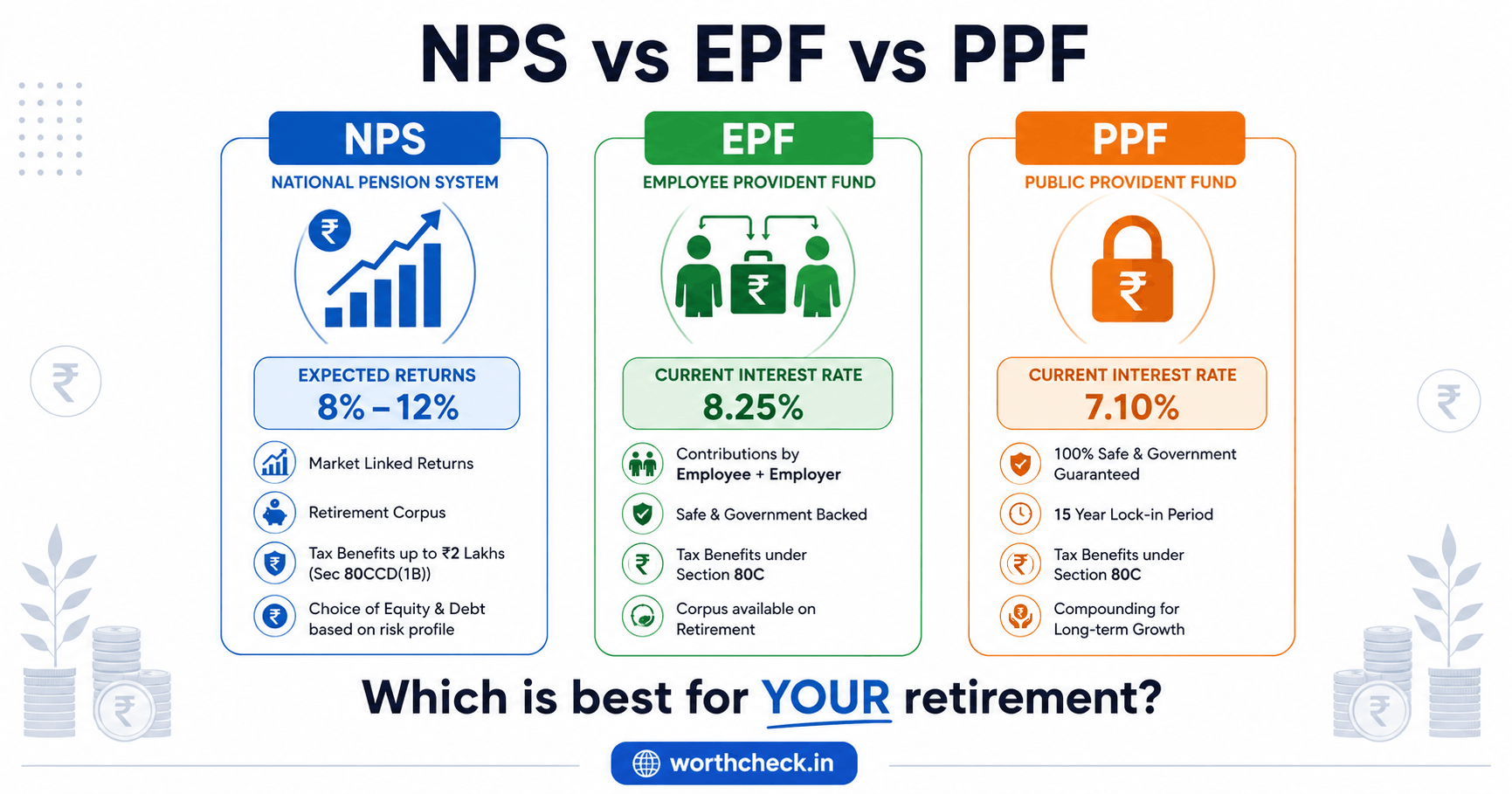
🎯 Quick Verdict
EPF is mandatory (if salaried) — and it's excellent
8.25% tax-free guaranteed returns with employer matching. This is free money. Never skip or withdraw early.
NPS gives extra Rs 50,000 tax benefit
If you're in 30% tax bracket, NPS saves Rs 15,600 extra per year via Section 80CCD(1B). That's beyond the Rs 1.5L limit of 80C.
PPF is for guaranteed, tax-free corpus
7.1% guaranteed, fully tax-free (EEE status), 15-year lock-in. Best for conservative investors who want zero risk.
Key Takeaways
- ✓EPF (8.25%): Best risk-adjusted returns. Employer contribution = 100% instant return on your money
- ✓NPS (8-12%): Highest potential returns + extra Rs 50K tax deduction. But 40% must buy annuity at retirement
- ✓PPF (7.1%): Safest option. Fully tax-free. Government guarantee. But lowest returns
- ✓Optimal strategy: EPF (mandatory) + NPS Rs 50K (for extra tax benefit) + PPF (remaining 80C)
- ✓30-year difference: Rs 1.5L/year invested = Rs 2.5 Cr (NPS) vs Rs 1.8 Cr (EPF) vs Rs 1.3 Cr (PPF)
⚠️ Important Disclaimer
This article is for educational purposes only and should not be considered financial advice. Past performance does not guarantee future results. Mutual fund investments and other financial products are subject to market risks. Please read all scheme information documents carefully before investing. We strongly recommend consulting a certified financial planner (CFP), registered investment advisor (RIA), or qualified financial professional for personalized guidance tailored to your specific financial situation.
The Retirement Planning Confusion Every Indian Faces
It starts with your first salary slip. You see "EPF Contribution" deducted. You vaguely know it's for retirement. Cool.
Then your CA uncle at Diwali says: "Beta, PPF khol lo. Tax bachega. Safe hai."
Your colleague who reads MoneyControl religiously chimes in: "NPS is better yaar. Extra Rs 50,000 tax benefit milta hai."
So now you have three retirement schemes, each claiming to be the best.
EPF, PPF, NPS. All sound similar. All involve saving for retirement. All give tax benefits.
But which one should you actually prioritize?
Here's the truth: all three are good. But they serve different purposes. And the optimal strategy isn't picking one — it's using all three intelligently based on your income and goals.
Let me break down each one, compare them head-to-head, and give you a concrete strategy.
What is EPF? (The One You Already Have)
EPF stands for Employee Provident Fund. If you work for a company with 20+ employees, EPF is mandatory. You've been contributing since your first job.
How EPF works:
- Your contribution: 12% of Basic + DA deducted from salary
- Employer contribution: 12% of Basic + DA (8.33% to EPS pension, 3.67% to EPF)
- Current interest rate: 8.25% for FY 2025-26 (tax-free)
- Lock-in: Until retirement (58 years), or 2 months unemployment gap
The magic of EPF:Your employer matches your contribution. When you put Rs 12,000, your employer adds another Rs 12,000 (though part goes to EPS). That's effectively a 100% instant return on your money before interest even kicks in.
EPF Rate History (Last 10 Years):
Pro tip:Never withdraw EPF when changing jobs. Transfer it to new employer's account. Breaking continuity kills the compounding magic.
What is PPF? (The Safe Savings Option)
PPF stands for Public Provident Fund. Unlike EPF, PPF is voluntary. Anyone can open it — salaried, self-employed, even housewives and students.
How PPF works:
- Who can open: Any Indian resident (not NRIs)
- Minimum investment: Rs 500/year
- Maximum investment: Rs 1.5 lakh/year (qualifies for 80C)
- Current interest rate: 7.1% (reviewed quarterly)
- Lock-in: 15 years (partial withdrawal after 7 years)
- Tax status: EEE (Exempt-Exempt-Exempt) — fully tax-free
Why people love PPF:It's the safest investment in India. Government guarantees both principal and interest. Market crashes don't affect it. You sleep peacefully knowing your money is 100% safe.
The catch?7.1% returns barely beat inflation. Over 30 years, you're preserving wealth, not growing it aggressively. Good for stability, not for wealth creation.
Smart PPF Strategy:
Invest before 5th of every month. Interest is calculated on lowest balance between 5th and end of month. Investing on 1st vs 6th can mean Rs 50,000+ difference over 15 years on Rs 1.5L annual investment.
What is NPS? (The Tax Saver with Market Returns)
NPS stands for National Pension System. It was originally for government employees but opened to everyone in 2009. NPS is unique because it invests your money in markets (equity, corporate bonds, government securities).
How NPS works:
- Who can open: Any Indian citizen (18-70 years)
- Account types: Tier 1 (retirement, locked) + Tier 2 (savings, flexible)
- Investment options: Equity (E), Corporate Bonds (C), Government Securities (G), Alternative (A)
- Expected returns: 8-12% depending on equity allocation
- Tax benefit: Rs 1.5L under 80C + Rs 50,000 EXTRA under 80CCD(1B)
- Lock-in: Until age 60 (partial withdrawal allowed after 3 years)
The killer feature of NPS:Section 80CCD(1B) gives you an EXTRA Rs 50,000 tax deduction beyond the Rs 1.5 lakh limit of 80C. If you're in the 30% bracket, that's Rs 15,600 saved in taxes every year.
NPS Tax Savings Calculation (30% bracket):
- 80CCD(1B) deduction: Rs 50,000
- Tax saved: Rs 50,000 × 30% = Rs 15,000
- Add 4% cess: Rs 15,000 × 1.04 = Rs 15,600 saved per year
- Over 25 years at 10% growth: Rs 15,600/year = Rs 16.3 lakh extra wealth
The catch? At retirement, you can only withdraw 60% as lump sum (tax-free). The remaining 40% MUST be used to buy an annuity (pension plan) which gives you monthly income but is taxable.
NPS Returns by Asset Class (10-Year Average):
The Returns Comparison: NPS vs EPF vs PPF
Let's compare head-to-head. Same investment, different outcomes.
| Feature | NPS | EPF | PPF |
|---|---|---|---|
| Returns (Expected) | 8-12% | 8.25% | 7.1% |
| Return Type | Market-linked | Guaranteed | Guaranteed |
| Employer Contribution | Optional (10% if Tier 1) | Yes (12%) | No |
| Tax on Contribution | 80C + 80CCD(1B) Rs 50K extra | 80C (Rs 1.5L limit) | 80C (Rs 1.5L limit) |
| Tax on Interest | Tax-free | Tax-free | Tax-free |
| Tax on Withdrawal | 60% tax-free, 40% annuity taxable | Tax-free (if >5 years) | Tax-free |
| Lock-in Period | Till age 60 | Till age 58 | 15 years |
| Partial Withdrawal | 25% after 3 years | Yes, for specific needs | 50% from 7th year |
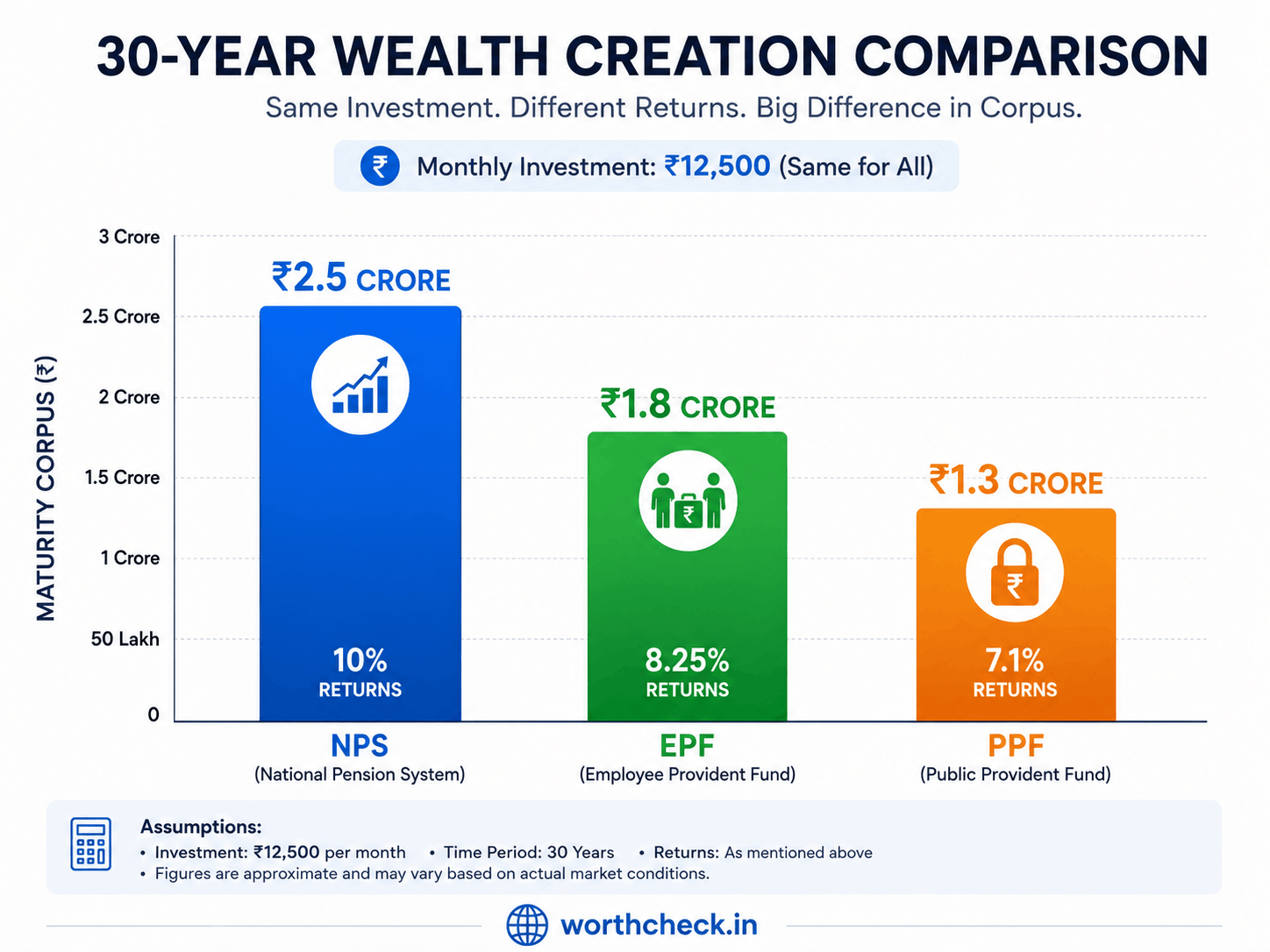
The key insight: EPF with employer matching is actually the best risk-adjusted return. Your employer adds 12% on top of your 12%, effectively doubling your contribution before interest.
Tax Benefits: The NPS Advantage Most People Miss
This is where NPS becomes really interesting. Let me break down the tax math.
NPS Tax Deductions
- 80CCD(1): Up to 10% of salary (within 80C Rs 1.5L limit)
- 80CCD(1B): Extra Rs 50,000 (beyond 80C limit)
- 80CCD(2): Employer contribution up to 14% (for govt) or 10% (for private)
- Total possible: Rs 2L+ deductions
EPF Tax Deductions
- 80C: Employee contribution (within Rs 1.5L limit)
- Employer contribution not taxed
- Interest tax-free
- Simple and automatic
PPF Tax Deductions
- 80C: Up to Rs 1.5L per year
- Interest fully tax-free
- Maturity fully tax-free
- EEE status (best tax treatment)
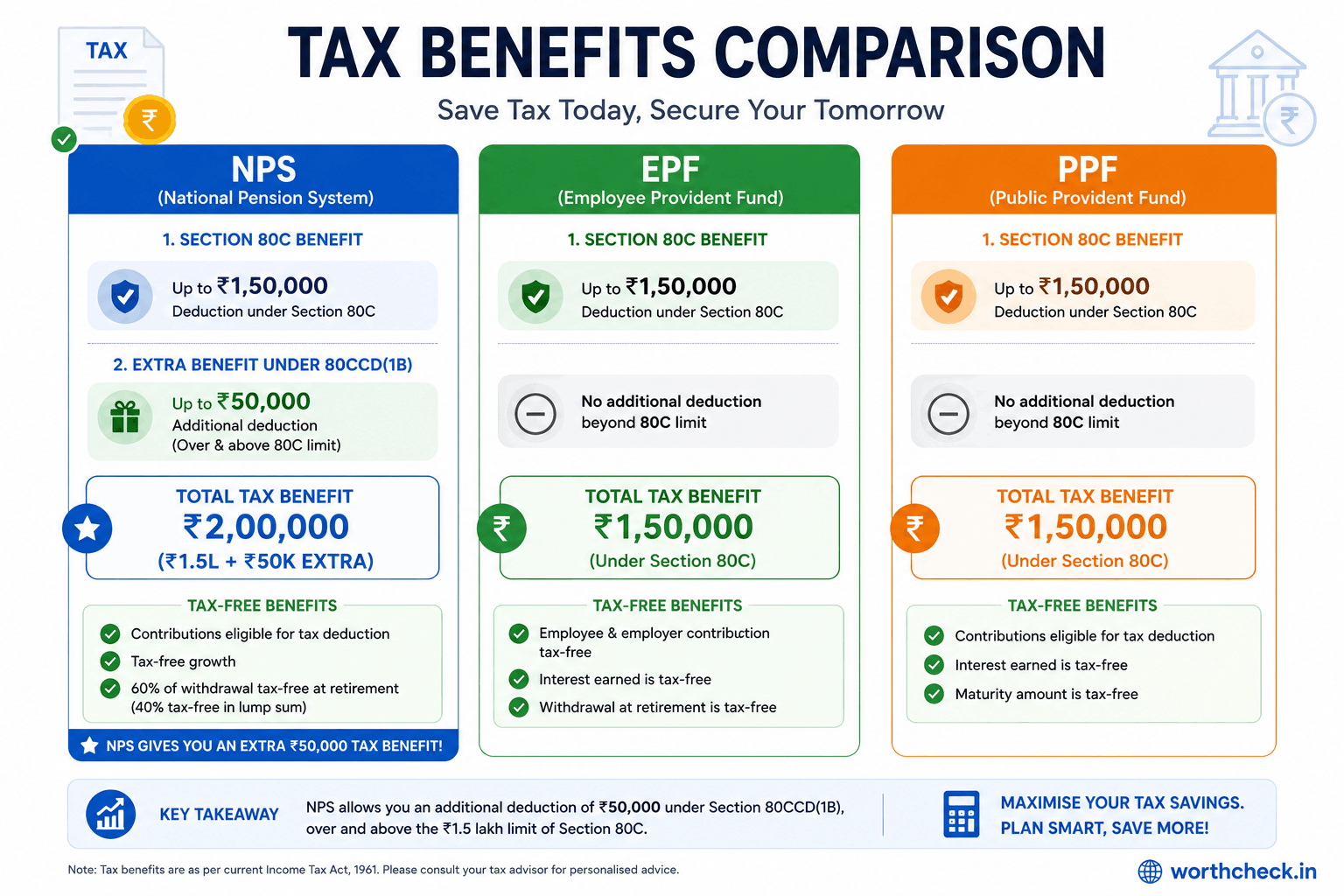
Example: Rs 15 Lakh Salary, Old Tax Regime
Without NPS:
- 80C (EPF + PPF + ELSS): Rs 1,50,000
- Total deductions: Rs 1,50,000
- Tax saved (30% bracket): Rs 46,800
With NPS (additional Rs 50K):
- 80C: Rs 1,50,000
- 80CCD(1B): Rs 50,000
- Total deductions: Rs 2,00,000
- Tax saved: Rs 62,400
Extra tax saved with NPS: Rs 15,600/year
Real Example: Rs 1.5 Lakh/Year for 30 Years
Let's see what happens when you invest Rs 1.5 lakh per year (Rs 12,500/month) in each scheme for 30 years.
📈 NPS
- Annual investment: Rs 1,50,000
- Total invested: Rs 45,00,000
- At 10% returns:
- Rs 2.49 Crore
- 60% lump sum: Rs 1.49 Cr (tax-free)
- 40% annuity: Rs 1 Cr (monthly pension)
🏛️ EPF
- Annual investment: Rs 1,50,000
- + Employer match: Rs 1,10,000*
- At 8.25% returns:
- Rs 2.56 Crore**
- 100% lump sum: Tax-free
- Plus EPS pension: Rs 7,500/month
*3.67% of Rs 1.5L to EPF, rest to EPS
**Including employer contribution
🔒 PPF
- Annual investment: Rs 1,50,000
- Total invested: Rs 45,00,000
- At 7.1% returns:
- Rs 1.54 Crore
- 100% lump sum: Tax-free
- Government guarantee
Surprised? EPF actually beats NPS when you include employer contribution. That's why salaried employees should never undervalue their EPF.
But here's the thing: you can't increase EPF contribution beyond the basic formula. NPS allows unlimited contribution with extra tax benefits. The optimal strategy uses both.
Calculate Your Retirement Corpus
See how much you'll have at retirement with different contribution amounts.
Withdrawal Rules: This is Where Things Get Complicated
Each scheme has different rules for when and how you can access your money. Understanding this is crucial for retirement planning.
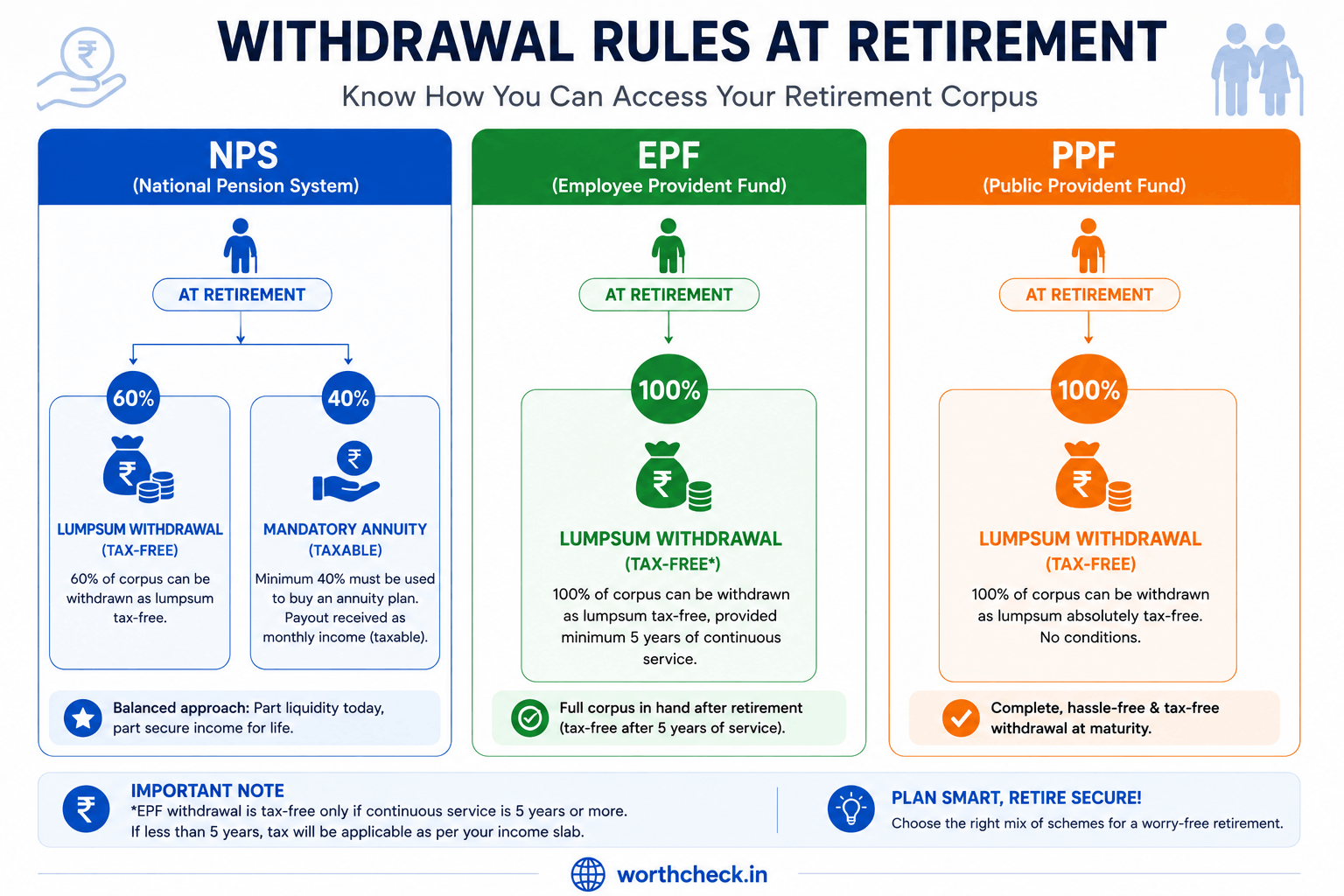
NPS Withdrawal Rules
- At retirement (60 years):
- • 60% as lump sum (tax-free)
- • 40% must buy annuity (monthly pension, taxable as income)
- Early withdrawal (before 60):
- • Only 20% lump sum allowed
- • 80% must buy annuity
- Partial withdrawal: Up to 25% after 3 years for specific needs (medical, education, home)
EPF Withdrawal Rules
- At retirement (58 years): 100% lump sum, tax-free if service >5 years
- Job change: Can withdraw or transfer (strongly recommend transfer)
- Unemployment: Full withdrawal after 2 months of unemployment
- Partial withdrawal: For home, medical, marriage, education (varying % allowed)
PPF Withdrawal Rules
- At maturity (15 years): 100% lump sum, completely tax-free
- Extension: Can extend in 5-year blocks indefinitely
- Partial withdrawal: 50% of balance from 7th year onwards (one withdrawal per year)
- Loan: Can take loan against PPF from 3rd to 6th year (at 1% above PPF rate)
The NPS Annuity Problem
The 40% mandatory annuity is NPS's biggest drawback. Current annuity rates are 5-6%. So your Rs 40 lakh in annuity gives only Rs 16,000-20,000/month, which is also taxable. Many experts argue you'd be better off managing that money yourself in a SWP (Systematic Withdrawal Plan) from mutual funds.
Which Should You Choose? Decision Framework

SALARIEDIf you're a salaried employee:
EPF is mandatory and excellent. Add NPS for the extra Rs 50K tax benefit. Use PPF to complete your 80C limit if needed. Priority: EPF > NPS > PPF.
SELF-EMPLOYEDIf you're self-employed:
No EPF option. Open both NPS and PPF. NPS for higher returns and extra tax benefit. PPF for guaranteed, safe portion. Priority: NPS (Rs 50K) > PPF (remaining 80C) > NPS (more if needed).
NEW REGIMEIf you're on New Tax Regime:
Only employer NPS contribution gives tax benefit. 80C and 80CCD(1B) don't apply. Still continue EPF (employer matches). PPF/NPS voluntary contributions are for pure retirement savings, not tax saving.
CONSERVATIVEIf you hate market risk:
Focus on EPF and PPF. Both are guaranteed. Skip or minimize NPS. Yes, you'll earn less, but you'll sleep better. Not everyone is built for market volatility.
The Optimal Strategy: Use All Three Intelligently
Here's how I structure my own retirement savings, and what I recommend for most salaried Indians in the 30% tax bracket:
Recommended Strategy (Rs 15L+ Salary, Old Regime)
EPF: Continue as is (mandatory)
12% of basic auto-deducted. Employer matches. Don't touch it. Transfer on job change.
NPS: Invest Rs 50,000/year for 80CCD(1B)
Extra tax deduction beyond 80C. Saves Rs 15,600/year. Choose aggressive equity allocation (75%) if young.
PPF: Invest remaining 80C limit
If EPF + any other 80C doesn't fill Rs 1.5L, add PPF. Guaranteed, safe, tax-free backup.
Beyond tax: Equity mutual funds
After maxing retirement tax benefits, invest additional money in index funds via SIP. More flexibility, higher returns.
Why this order? EPF is mandatory and has employer matching. NPS gives extra tax benefit. PPF fills gaps in 80C. And equity mutual funds outside retirement accounts give you flexibility — no lock-in, no forced annuity.
Final Verdict: It's Not Either/Or — It's Both/And
The biggest mistake people make is treating NPS, EPF, and PPF as competing options. They're not. Each serves a different purpose in a well-rounded retirement strategy.
EPF
Best risk-adjusted returns with employer matching. Your foundation.
NPS
Extra tax benefit + market returns. Your growth accelerator.
PPF
Guaranteed safety net. Your sleep-well money.
The right mix depends on your tax bracket, risk tolerance, and retirement timeline. But for most salaried Indians under 45: maximize EPF (it's automatic), add Rs 50K NPS for tax benefit, and fill remaining 80C with PPF.
Start today. Compounding needs time to work its magic.
Plan Your Retirement
Calculate exactly how much you need and how to get there
Frequently Asked Questions
1. Can I invest in all three — NPS, EPF, and PPF?
Yes, and you should! Each serves a different purpose. EPF is mandatory for salaried. NPS gives extra tax benefit. PPF provides guaranteed returns. They complement each other in a retirement portfolio.
2. Is NPS better than EPF?
Not necessarily. EPF with employer matching gives effectively 100% instant return + 8.25% guaranteed. NPS might give higher returns (10-12%) but has no employer matching (usually) and forces 40% into annuity. EPF is better risk-adjusted; NPS is better for extra tax saving.
3. What is Section 80CCD(1B) in NPS?
It's an EXTRA Rs 50,000 tax deduction for NPS investment, BEYOND the Rs 1.5 lakh limit of 80C. So you can claim Rs 1.5L (80C for EPF/PPF/ELSS) + Rs 50K (80CCD(1B) for NPS) = Rs 2 lakh total deduction. In 30% bracket, that extra Rs 50K saves Rs 15,600 in tax.
4. What is the 40% annuity rule in NPS?
At retirement (age 60), you can withdraw only 60% of your NPS corpus as lump sum (tax-free). The remaining 40% MUST be used to buy an annuity from an insurance company. This gives you monthly pension but the income is taxable. Many consider this a drawback.
5. Can I withdraw PPF before 15 years?
Partially, yes. From the 7th year onwards, you can withdraw up to 50% of the balance (one withdrawal per year). You can also take a loan against PPF from 3rd to 6th year. But full withdrawal requires completing 15 years or special circumstances.
6. Should I choose NPS or PPF if I can only pick one?
If you're in 30% tax bracket and want to maximize tax savings: NPS (for the extra Rs 50K deduction). If you want guaranteed, safe, fully tax-free returns and don't need the extra deduction: PPF. If you're on new tax regime: Neither gives tax benefit on contribution, so choose based on returns — NPS for higher potential, PPF for safety.
7. What happens to EPF if I lose my job?
You can withdraw full EPF balance after 2 months of unemployment. However, this is usually a bad idea — you lose the compounding. Better to let it sit and grow, or transfer to new employer when you get a job. Withdrawal before 5 years of service is also taxable.
8. NPS or mutual fund SIP — which is better?
For retirement with tax benefit: NPS (extra Rs 50K deduction). For flexibility and no forced annuity: Mutual funds. Ideal strategy: Rs 50K in NPS for tax benefit, rest in equity mutual funds for flexibility. Mutual funds have no lock-in, no mandatory annuity, and you control withdrawal timing.
Related Articles
Written by
Sid Joshi
Founder, WorthCheck.in