Written by Sid Joshi
Founder, WorthCheck.in
LIC vs SIP: Which is Better in 2026? A Rs 50,000/Year Comparison
Your uncle says LIC is safe. Your colleague swears by SIPs. Your parents bought you a policy when you were 5. Who is right? I ran the numbers on a Rs 50,000/year investment over 20 years. The difference will shock you.
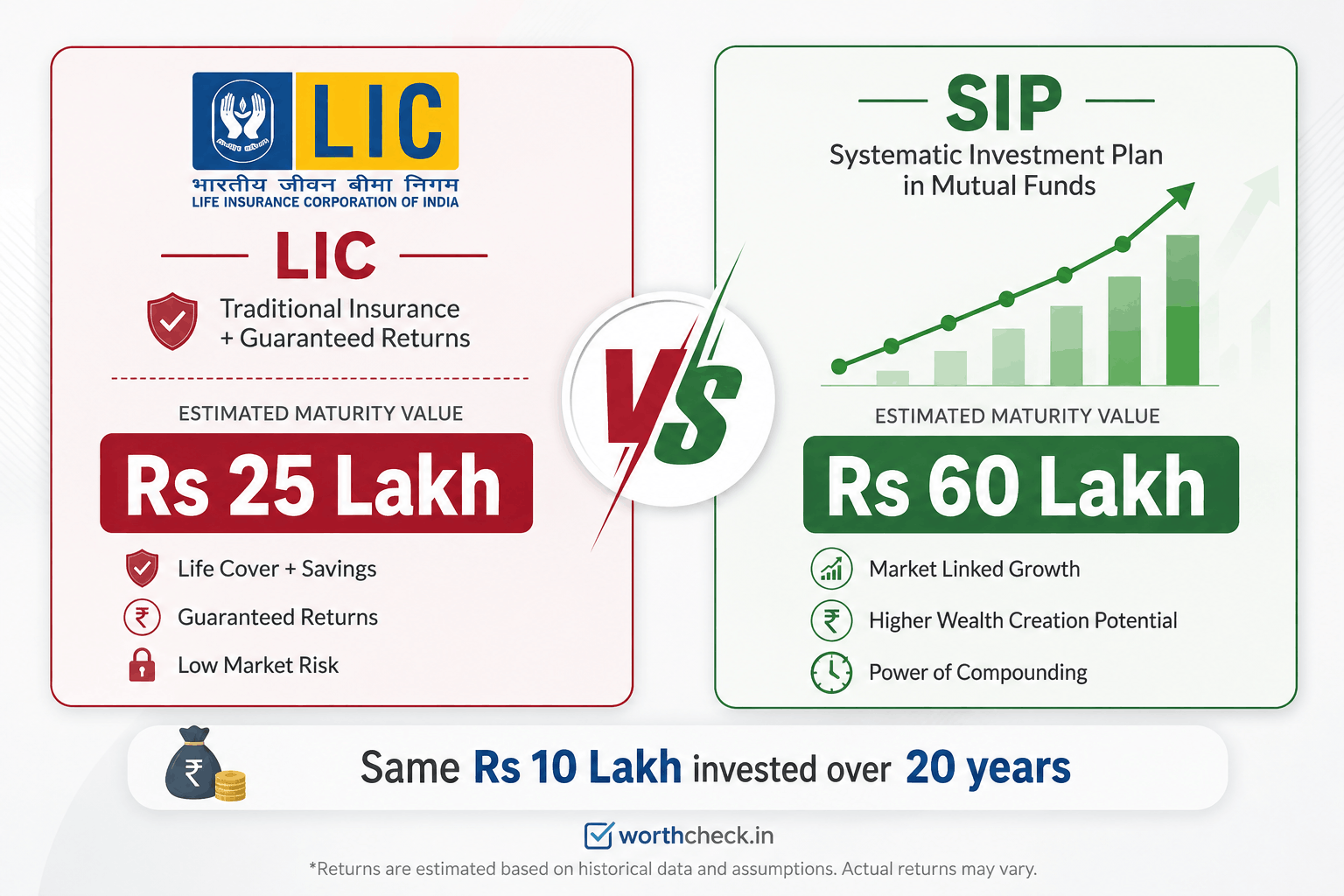
🏆 Quick Verdict
SIP wins for wealth creation
For most Indians under 50, SIP in equity mutual funds beats LIC by a wide margin. Historically, SIPs have delivered 12-15% returns compared to LIC's 5-6%. Over 20 years, this means 3X more money.
LIC is insurance, not investment
If you need life insurance, buy a term plan for Rs 500-1,000/month. Invest the rest in SIPs. This "term + SIP" combo gives you better returns AND better coverage.
Already have LIC? Read before surrendering
If you've paid 5+ years of premium, calculate the surrender value carefully. Sometimes it makes sense to continue. I'll show you how to decide.
Key Takeaways
- ✓LIC returns 5-6%: Most endowment and money-back policies give returns barely beating inflation
- ✓SIP returns 12-15%: Nifty 50 index funds have given 12-14% CAGR over any 15+ year period
- ✓Rs 50,000/year for 20 years: LIC gives Rs 22-25 lakh. SIP gives Rs 55-75 lakh.
- ✓Insurance is separate: Buy term insurance for 10-20X your annual income. Use SIP for wealth.
- ✓Tax benefits are same: Both get 80C deduction. ELSS SIPs even have shorter lock-in (3 years vs 5-20 years).
⚠️ Important Disclaimer
This article is for educational purposes only and should not be considered financial advice. Past performance does not guarantee future results. Mutual fund investments and other financial products are subject to market risks. Please read all scheme information documents carefully before investing. We strongly recommend consulting a certified financial planner (CFP), registered investment advisor (RIA), or qualified financial professional for personalized guidance tailored to your specific financial situation.
The Conversation Every Indian Family Has
It happens at every family gathering. Your uncle, the one who retired from a government job, corners you near the snacks table.
"Beta, LIC liya kya? I have 7 policies. Completely safe. Government guarantee hai. When I retired, I got Rs 35 lakh."
"These SIP-VIP things are all gambling. Stock market mein paisa doob jaata hai. My friend lost everything in 2008."
And you nod, because what do you say? Your uncle is older, experienced, and seems so confident.
But here's the thing nobody tells you: your uncle's Rs 35 lakh payout after 30 years of premiums? If he had invested the same amount in a simple index fund, he would have had Rs 1.5 crore.
That's not a typo. His "safe" investment cost him over Rs 1 crore in opportunity.
Let me show you exactly why this happens, and what you should do instead.
What is an LIC Policy? (The Truth Nobody Tells You)
LIC (Life Insurance Corporation of India) is the largest insurance company in India. When people say "LIC policy," they usually mean endowment plans or money-back policies like:
- LIC Jeevan Anand
- LIC Jeevan Labh
- LIC New Endowment Plan
- LIC Money Back Policy
These policies promise two things: insurance coverage and investment returns. Pay a fixed premium every year for 15-20 years, and at maturity, you get a lump sum.
Here's what they don't tell you:
- Low insurance cover: A Rs 50,000/year policy might give only Rs 10-15 lakh death benefit. Term insurance at that premium gives Rs 1-2 crore.
- Returns of 5-6%: When you calculate the IRR (internal rate of return) on maturity amount, it's typically 5-6%. Fixed deposits give 7%.
- Lock-in for decades: Miss a premium? Lose all your money. Need cash urgently? Surrender value is pathetic for first 5-7 years.
Who it's for: People who cannot trust themselves to invest regularly. LIC forces discipline through agent pressure and fear of losing money. If you genuinely cannot save without someone breathing down your neck, LIC might actually help you.
The downside? You pay a heavy price for that discipline. About 50-60% less wealth over 20 years compared to SIP.
What is SIP? (And Why Everyone is Talking About It)
SIP stands for Systematic Investment Plan. It's not a product. It's a method of investing in mutual funds.
Instead of investing a lump sum, you invest a fixed amount every month. Rs 5,000 on the 5th of every month, automatically debited from your bank account.
Three reasons SIP makes sense:
- 1. No timing needed: You buy units at different prices every month. Sometimes high, sometimes low. Over time, it averages out. This is called rupee cost averaging.
- 2. Compounding works harder: Equity mutual funds have historically given 12-15% returns. At 12%, your money doubles every 6 years.
- 3. Flexibility: Stop anytime. Increase anytime. Withdraw anytime (after exit load period). No agent pressure.
Who it's for: Anyone who can commit to investing monthly and has patience to stay invested for 7-10+ years. You need to be comfortable with short-term volatility.
The downside? No guaranteed returns. Markets can crash 30-40% in a bad year. You need emotional discipline to not panic-sell. Also, no insurance coverage.
The Returns Comparison: LIC vs SIP (Real Numbers)
Let's look at actual historical data. Not marketing brochures.
| Metric | LIC Endowment | Equity SIP |
|---|---|---|
| Historical Returns (CAGR) | 5-6% | 12-15% |
| Returns vs Inflation (6%) | Barely beats | Beats by 6-9% |
| Guaranteed? | Partially (sum assured + bonus) | No guarantee |
| Best 20-year return | 7-8% | 18-20% |
| Worst 20-year return | 4-5% | 10-11% |
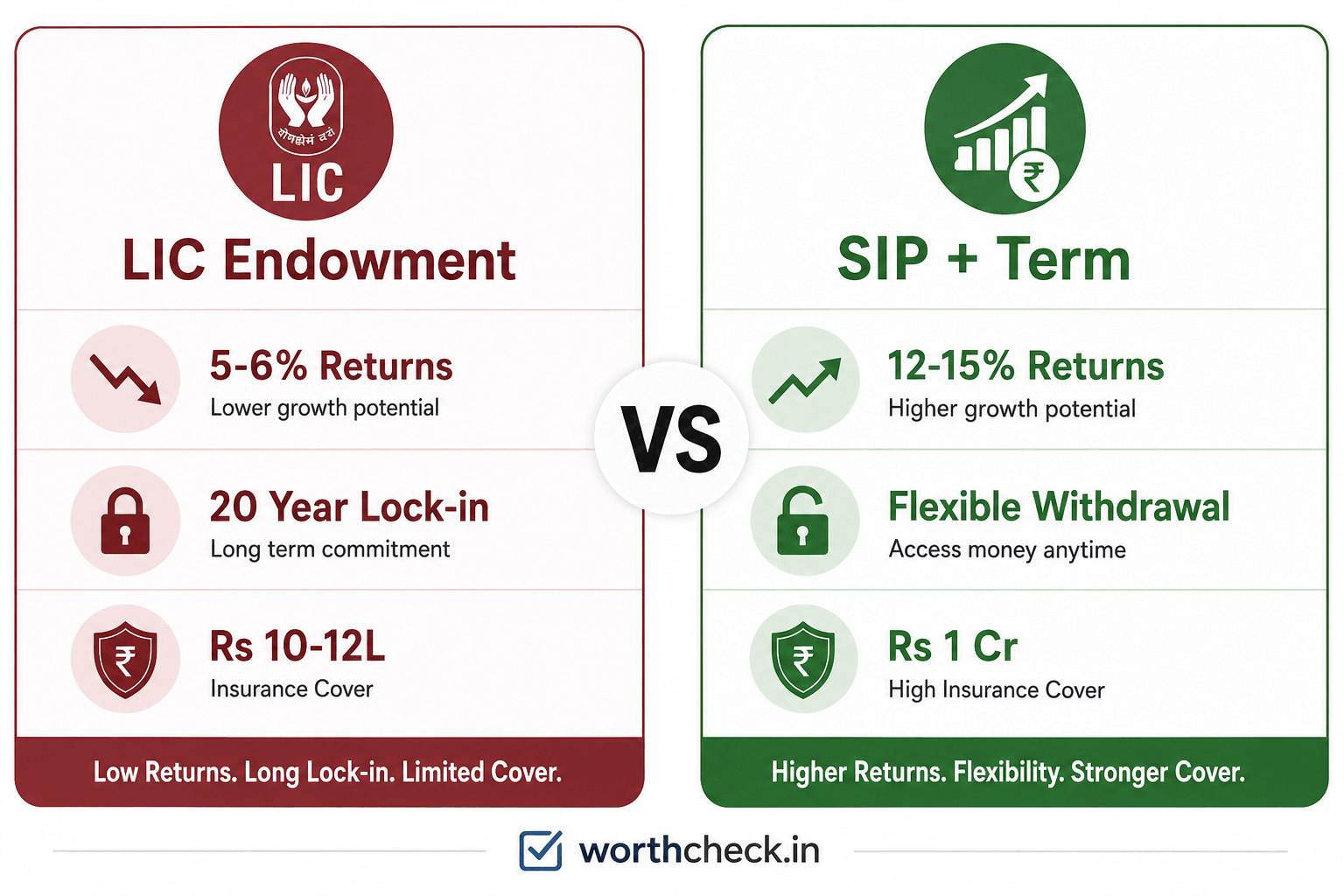
That last row is the key. Even in the worst 20-year period for Indian equity markets (which included the 2008 crash, the 2020 COVID crash, and multiple smaller corrections), SIP in Nifty 50 delivered 10-11% returns.
LIC's best-case scenario barely matches SIP's worst-case scenario.
Real Example: Rs 50,000/Year for 20 Years
Let's say you have Rs 50,000 to invest every year. That's about Rs 4,167/month. Here's what happens:
Option A: LIC Jeevan Anand
- Premium: Rs 50,000/year for 20 years
- Total invested: Rs 10,00,000
- Sum assured: Rs 10-12 lakh
- Maturity value: Rs 22-25 lakh*
- Effective return: 5.5-6%
*Based on recent LIC bonus rates
Option B: SIP in Nifty 50 Index Fund
- SIP: Rs 4,167/month for 20 years
- Total invested: Rs 10,00,000
- At 12% CAGR: Rs 41 lakh
- At 15% CAGR: Rs 61 lakh
- Insurance: None (buy separately)
*Based on Nifty 50 historical returns
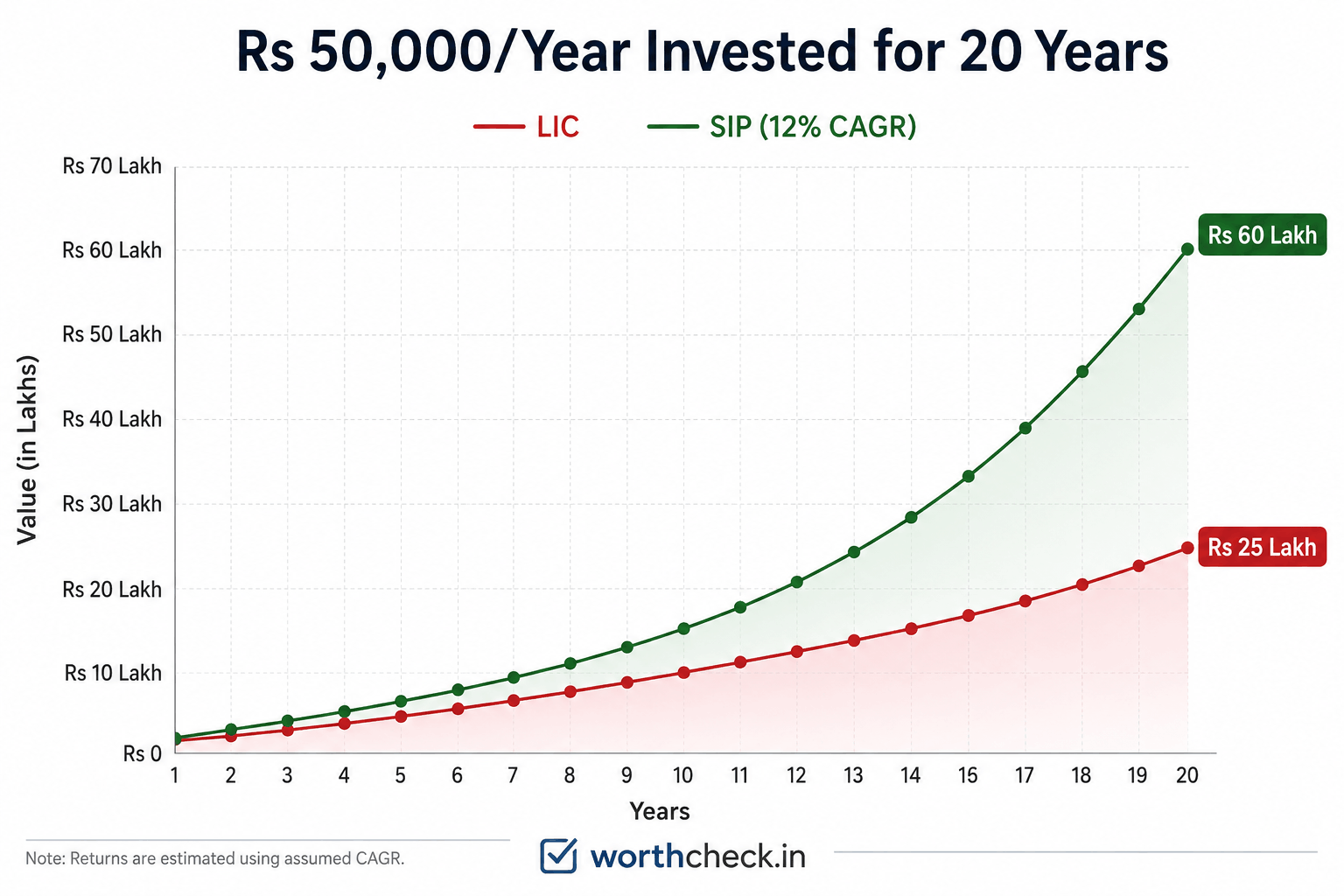
Same Rs 10 lakh invested. LIC gives you Rs 22-25 lakh. SIP gives you Rs 41-61 lakh.
But wait, you say. What about insurance? Fair point. Let me add term insurance to the SIP option.
The Smart Combo: Term + SIP
- Term Insurance: Rs 1 crore cover for Rs 12,000/year (age 30, healthy)
- SIP: Rs 38,000/year in index fund
- Total: Rs 50,000/year (same as LIC premium)
- After 20 years: Rs 32-48 lakh (SIP) + Rs 1 crore death benefit (if needed)
You get Rs 1 crore insurance (vs Rs 10-12 lakh from LIC) AND Rs 32-48 lakh wealth (vs Rs 22-25 lakh from LIC).
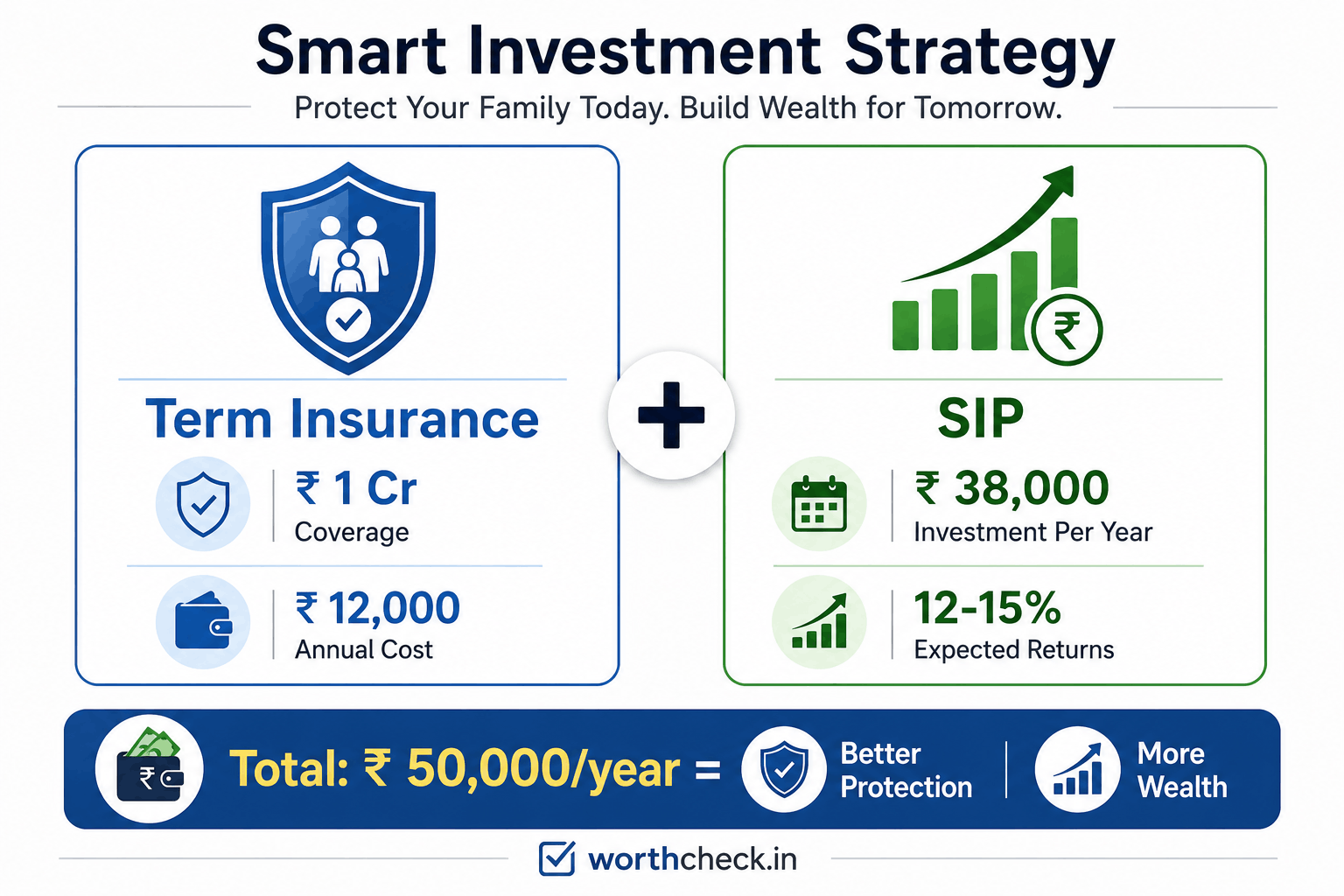
This is why financial advisors keep saying "term insurance + mutual funds." It's not marketing. It's math.
The Insurance Myth: Why LIC is a Bad Deal
LIC agents love to say: "You get insurance AND investment in one product!"
This is like saying: "This Honda City can also fly! It's a car AND a plane!"
Would you buy a car that can barely drive and barely fly? No. You'd buy a proper car and, if you need to fly, buy a plane ticket.
Same logic applies to LIC. It gives you bad insurance AND bad returns. You're better off buying them separately.
Insurance comparison for Rs 50,000/year premium:
For the same money, term insurance gives you 8-10X more coverage.
Liquidity & Flexibility: When You Need Money Urgently
Life happens. You might need money urgently. Maybe a medical emergency. Maybe a job loss. Maybe a business opportunity.
LIC liquidity:Terrible. If you surrender in the first 3 years, you get nothing. After 3 years, you get maybe 30-50% of what you paid. After 10 years, you might get 60-70%. You're basically trapped.
SIP liquidity: Excellent. Most equity funds have a 1-year exit load (1% fee if you withdraw within a year). After that, your money is available in 2-3 working days. No questions asked.
You can also take a loan against LIC policy, but the interest rate is 9-10%. And you still have to pay premiums.
Tax Benefits: Both Get 80C, But...
LIC agents often push the tax benefit angle. "You get 80C deduction!"
True. But so does ELSS (tax-saving mutual funds). And ELSS has:
- Shorter lock-in: 3 years (vs 5-20 years for LIC)
- Better returns: 12-18% historically
- Same 80C benefit: Up to Rs 1.5 lakh deduction
On maturity taxation:
- LIC: Maturity amount is tax-free under section 10(10D) if annual premium is less than Rs 5 lakh
- Equity funds: Long-term capital gains above Rs 1.25 lakh are taxed at 12.5%
Yes, LIC has a tax advantage on maturity. But the extra returns from SIP more than compensate for the tax.
Quick Math:
LIC maturity: Rs 25 lakh (tax-free) = Rs 25 lakh in hand
SIP maturity: Rs 50 lakh. Tax on Rs 50L-Rs 10L invested = Rs 40L gains. Tax on gains above Rs 1.25L = Rs 38.75L x 12.5% = Rs 4.84L. You keep Rs 45.16 lakh.
Even after tax, SIP gives you Rs 20 lakh more.
Already Have an LIC Policy? Here's What to Do
I know many of you are reading this thinking: "But I already have LIC policies! My parents bought them when I was a kid!"
Don't panic. Here's how to think about it:
Calculate Your Surrender Value
Use our free calculator to see exactly what you'll get if you surrender.
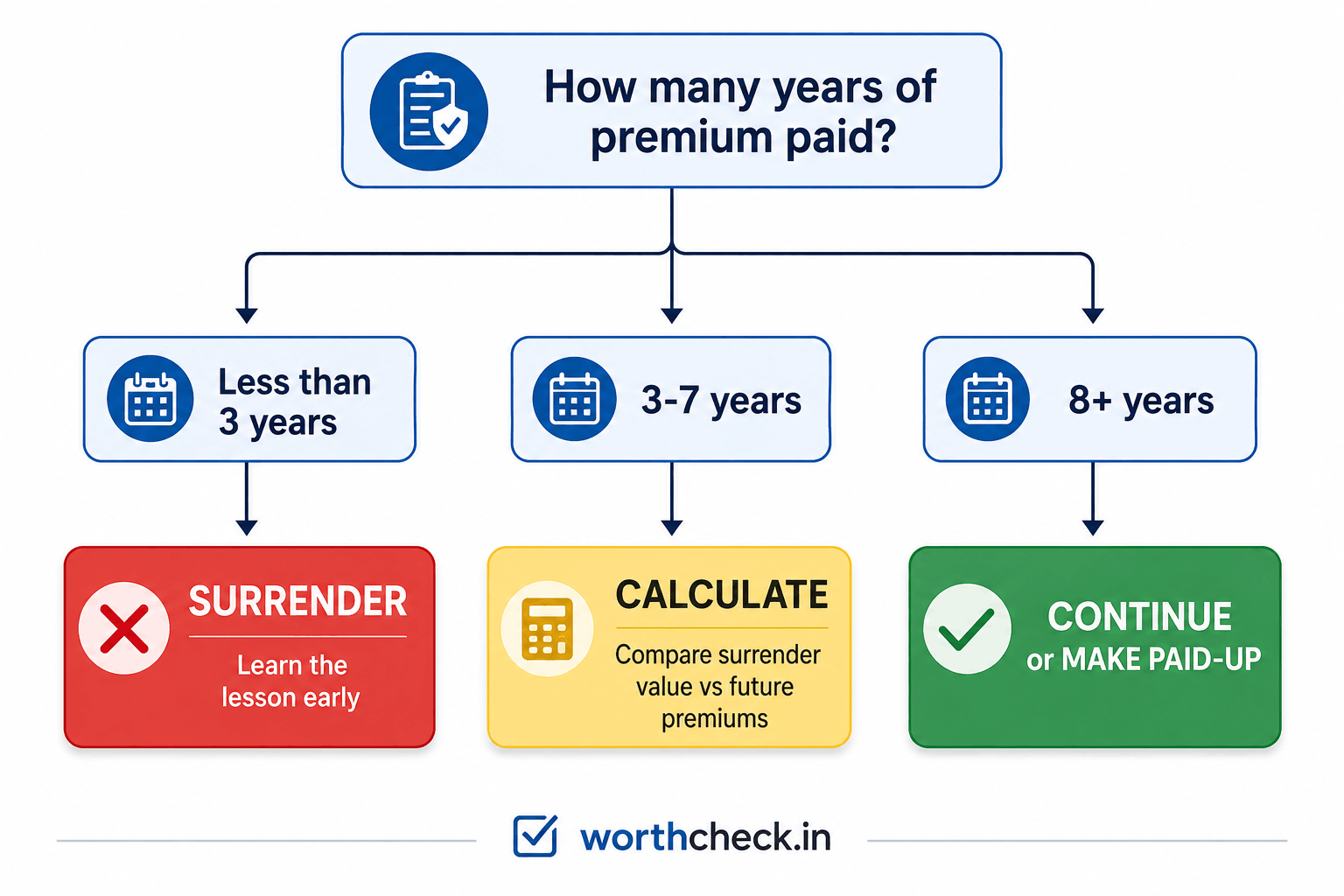
If you've paid less than 3 years of premium:
Surrender. You'll lose 70-80% of what you paid, but that's still better than continuing a bad investment for 15 more years. Learn the lesson early.
If you've paid 3-7 years:
Calculate the surrender value vs future premiums. If remaining premiums are more than 60% of maturity value, consider surrendering. Use the money to start SIP.
If you've paid 8+ years:
Usually better to continue. The surrender value is too low, and you've already suffered the worst returns. Make the policy "paid up" (stop paying premium, accept lower maturity) if possible.
Pro tip: Call LIC customer care (1800-2020-8787) and ask for the exact surrender value and paid-up value. Do the math before deciding.
When LIC Actually Makes Sense
I've been harsh on LIC, but there are situations where it might be the right choice:
- You cannot trust yourself to invest:If you know you'll skip SIP payments, redeem at the first market dip, or spend the money on gadgets, LIC's forced discipline might actually help.
- You have zero risk tolerance:Some people genuinely cannot sleep at night if their portfolio shows -5%. LIC's guarantee provides peace of mind.
- You need insurance but are unhealthy: If you have pre-existing conditions, term insurance premiums can be very high or you may be rejected. LIC accepts almost everyone (with higher premium).
- You're over 50 with no other savings: At this point, the remaining time horizon is shorter. Guaranteed returns matter more.
For everyone else under 45 with stable income and basic financial literacy, SIP is the better choice.
How to Start Your SIP Journey
Ready to start? Here's the simple process:
Buy term insurance first
Get Rs 50 lakh to Rs 1 crore cover. Costs Rs 8,000-15,000/year. Use PolicyBazaar or directly from HDFC Life, ICICI Prudential.
Open a mutual fund account
Use Groww, Zerodha Coin, or MF Central. Takes 10 minutes with Aadhaar eKYC.
Choose a simple index fund
Start with Nifty 50 Index Fund or UTI Nifty 50 Index Fund. Expense ratio under 0.2%. No need for complicated funds.
Set up auto-debit SIP
Link your bank account and set SIP date right after salary credit (5th or 7th). Treat it like a bill payment.
Forget about it for 10 years
Don't check daily NAV. Don't panic during crashes. Set up step-up SIP (increase by 10% yearly). Let compounding work.
That's it. No agents. No paperwork. No pressure to buy more policies.
Final Verdict: SIP Wins, But It's Not for Everyone
Let me be direct:
For 90% of Indians under 45 with stable income:Skip LIC endowment policies. Buy term insurance. Start SIP in index funds. You'll build 2-3X more wealth with better insurance coverage.
For the other 10%:If you genuinely cannot discipline yourself, if market volatility keeps you up at night, or if you have health issues preventing term insurance, LIC might be your only option. That's okay. Some savings is better than no savings.
The important thing is to make an informed choice. Now you have the numbers.
Calculate Your SIP Returns
See exactly how much wealth you can build with SIP
Frequently Asked Questions
1. Is LIC completely bad?
Not completely. LIC is the safest insurance company in India with government backing. The problem is using it as an investment vehicle. LIC is good for insurance (term plans), but bad for wealth creation (endowment policies).
2. What if the stock market crashes?
Markets crash. They've crashed in 2000, 2008, 2020. And every single time, they've recovered and gone higher within 2-3 years. If you stay invested through SIP, crashes are actually good. You buy more units at lower prices. The key is patience.
3. Should I surrender my existing LIC policy?
Depends on how many years you've paid. Less than 3 years: Yes, surrender. 3-7 years: Calculate and decide. 8+ years: Usually continue or make it paid-up. Call 1800-2020-8787 for exact surrender value.
4. How much SIP should I start with?
Start with whatever you can afford consistently. Even Rs 1,000/month is fine. The key is consistency. Once you build the habit, increase it by 10% every year (step-up SIP). Don't wait for a "perfect amount."
5. My father insists I should buy LIC. What do I say?
Don't fight. Show him this article. Show him the numbers. If he still insists, buy the smallest LIC policy to keep peace (Rs 10,000/year max) and quietly start your SIP. Sometimes family harmony is worth Rs 10,000/year.
6. Is SIP taxed differently from LIC?
LIC maturity is tax-free (if annual premium is under Rs 5 lakh). Equity SIP gains above Rs 1.25 lakh are taxed at 12.5%. But the higher returns from SIP more than compensate for this tax. After-tax, SIP still gives you significantly more.
7. Can I have both LIC and SIP?
Yes, but why? If you want insurance, buy term insurance. If you want investment, do SIP. Combining them in one LIC policy means you get worse of both. The only reason to have both is if you already have LIC and it doesn't make sense to surrender.
8. What about ULIP? Is that better than LIC endowment?
ULIPs (Unit Linked Insurance Plans) invest in markets like mutual funds, but have higher charges. After 2010 IRDA reforms, charges reduced, but still higher than direct mutual funds. Skip ULIPs too. Buy term insurance + mutual fund SIP separately.
Related Articles
Written by
Sid Joshi
Founder, WorthCheck.in