Written by Sid Joshi
Founder, WorthCheck.in
Emergency Fund India 2026: How Much, Where to Keep, and How to Build It Fast
Lost your job? Medical emergency? Car breakdown? Without an emergency fund, you'll either dip into investments or take a loan. I'll show you exactly how much you need, where to park it, and how to build it in 12 months — even on an average salary.
🛡️ Quick Verdict
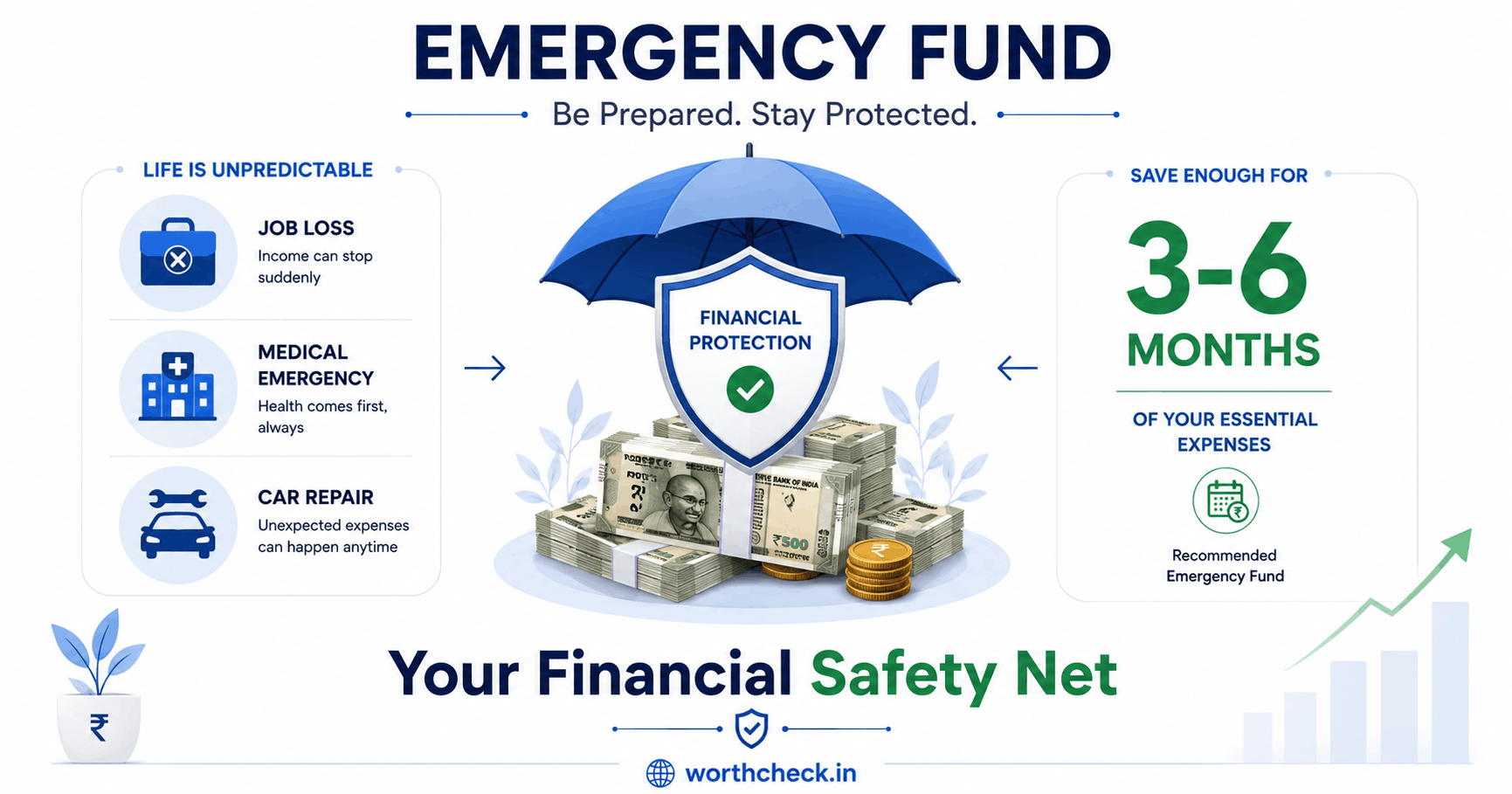
The Magic Number: 6 months of expenses
For most salaried Indians, 6 months of essential expenses is the sweet spot. Not 3 months (too risky), not 12 months (too much idle cash). Calculate your monthly essentials, multiply by 6.
Split it smartly: Savings + Liquid Funds
Keep 1-2 months in savings account (instant access). Put 4-5 months in liquid mutual funds (6.5% returns, T+1 redemption). Don't leave everything in a 3.5% savings account.
Build before you invest
Emergency fund comes FIRST. Before SIPs, before stocks, before that vacation. Without it, you'll sell investments at a loss during emergencies or take high-interest loans.
Key Takeaways
- ✓Rule of thumb: 3 months (govt jobs), 6 months (corporate), 9-12 months (freelancers/business)
- ✓Calculate essentials: Rent + food + utilities + EMIs + insurance. Skip optional spending.
- ✓Where to keep: 1-2 months in savings (3.5%), 4-5 months in liquid funds (6.5%)
- ✓Build target: Save 20% of income until you hit your number
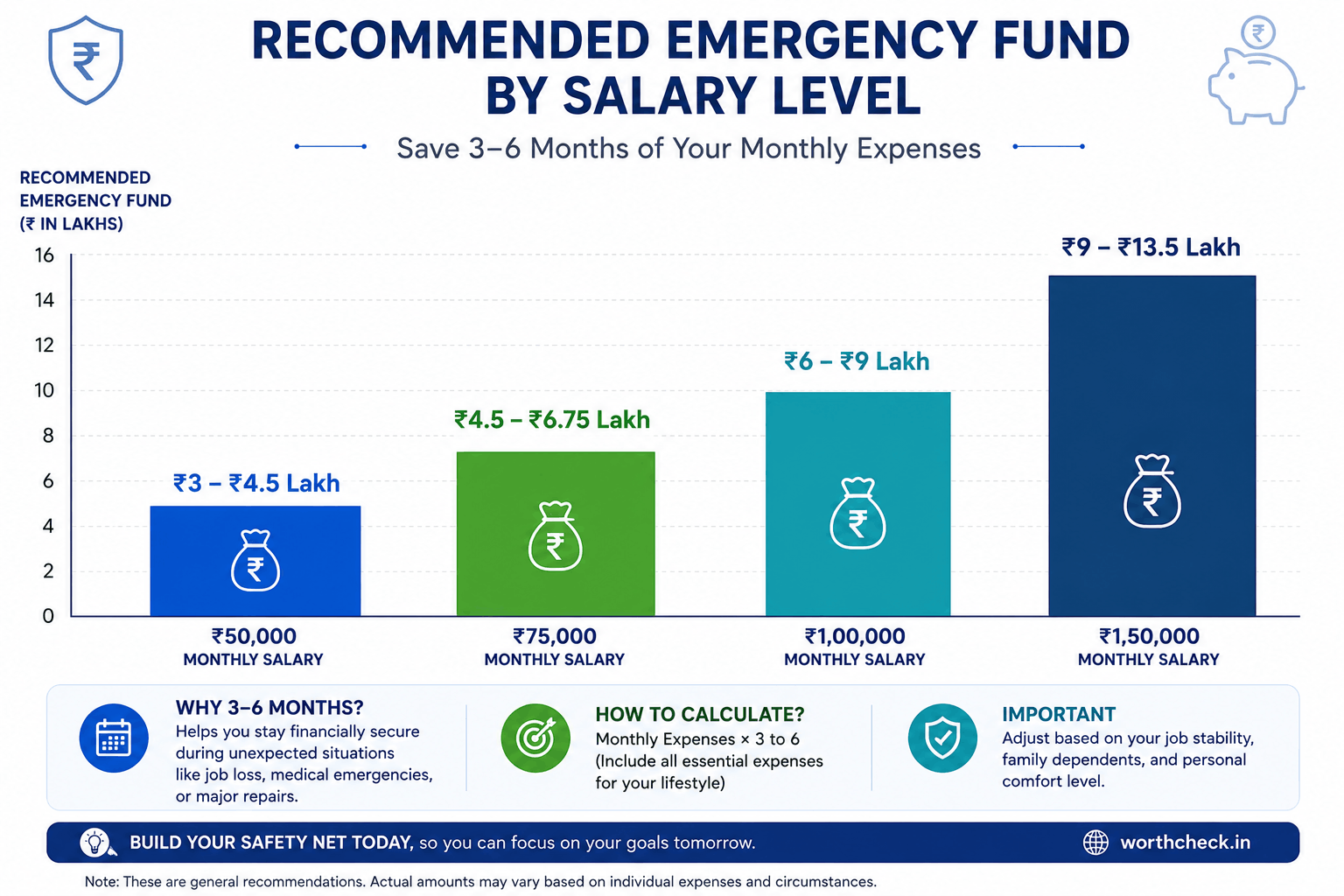
- ✓By salary: Rs 50K → Rs 3-4.5L, Rs 1L → Rs 6-9L, Rs 1.5L → Rs 9-13.5L
⚠️ Important Disclaimer
This article is for educational purposes only and should not be considered financial advice. Past performance does not guarantee future results. Mutual fund investments and other financial products are subject to market risks. Please read all scheme information documents carefully before investing. We strongly recommend consulting a certified financial planner (CFP), registered investment advisor (RIA), or qualified financial professional for personalized guidance tailored to your specific financial situation.
The Day I Learned Why Emergency Funds Matter
March 2020. COVID-19 hit. My startup's revenue dropped 70% in two weeks.
No one was hiring. Clients froze budgets. The economy went into freefall.
I watched colleagues break their FDs at penalties, sell mutual funds at a 30% loss, and max out credit cards. Some borrowed from family. Some took personal loans at 15% interest.
Meanwhile, I had 8 months of expenses sitting in a boring combination of savings account and liquid funds.
I didn't panic. I didn't sell. I waited it out.
That emergency fund wasn't just money. It was peace of mind.
Since then, I've spoken to hundreds of people about personal finance. The #1 regret? "I wish I had built an emergency fund before investing."
Let me show you exactly how to build yours.
What is an Emergency Fund? (And What It's NOT)
An emergency fund is money set aside for unexpected, urgent financial needs. It's your buffer between "life happens" and "financial disaster."
Emergency fund IS for:
- ✓ Job loss or salary cut
- ✓ Medical emergency (yours or family's)
- ✓ Major car/bike repair
- ✓ Urgent home repair (roof leak, AC breakdown)
- ✓ Family emergency requiring immediate travel
- ✓ Legal issues or unexpected taxes
Emergency fund is NOT for:
- ✗ That iPhone you "need"
- ✗ Vacation because you're "stressed"
- ✗ Wedding expenses (plan separately)
- ✗ Stock market "opportunity"
- ✗ Home down payment (save separately)
- ✗ Lending to friends/relatives
The golden rule:If it's not unexpected AND urgent, it's not an emergency. Create separate savings goals for planned expenses.
How Much Emergency Fund Do You Need?
The classic advice is "3-6 months of expenses." But that's too generic. Your magic number depends on your specific situation.
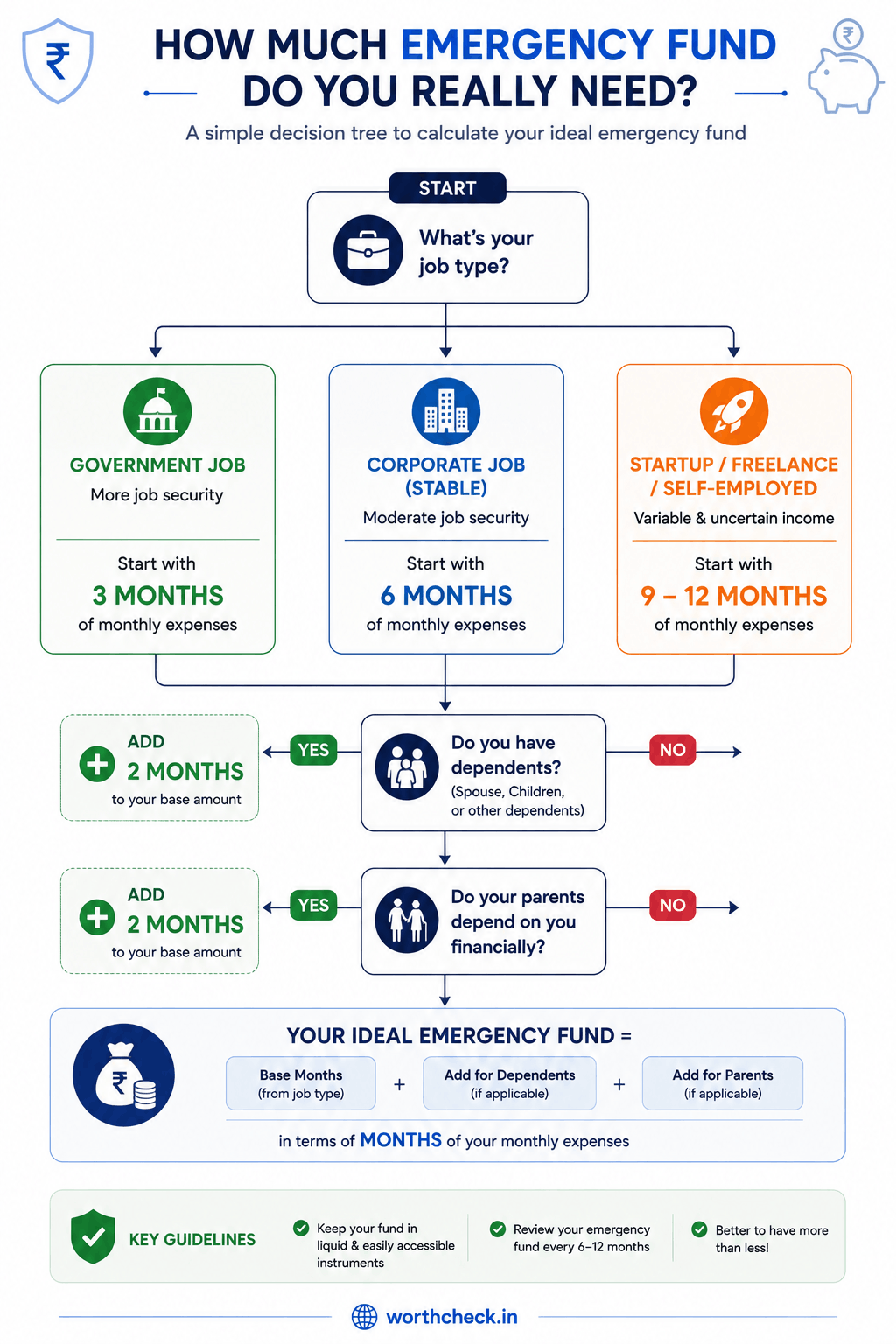
| Your Situation | Months Needed | Why |
|---|---|---|
| Government job, single | 3 months | Highest job security, no dependents |
| Corporate job, stable company | 6 months | Average job search takes 3-6 months |
| Startup, single income family | 9 months | Higher layoff risk, no backup income |
| Freelancer/Self-employed | 9-12 months | Income volatility, no severance |
| Dependent parents + spouse + kids | +2-3 months | More people = more potential emergencies |
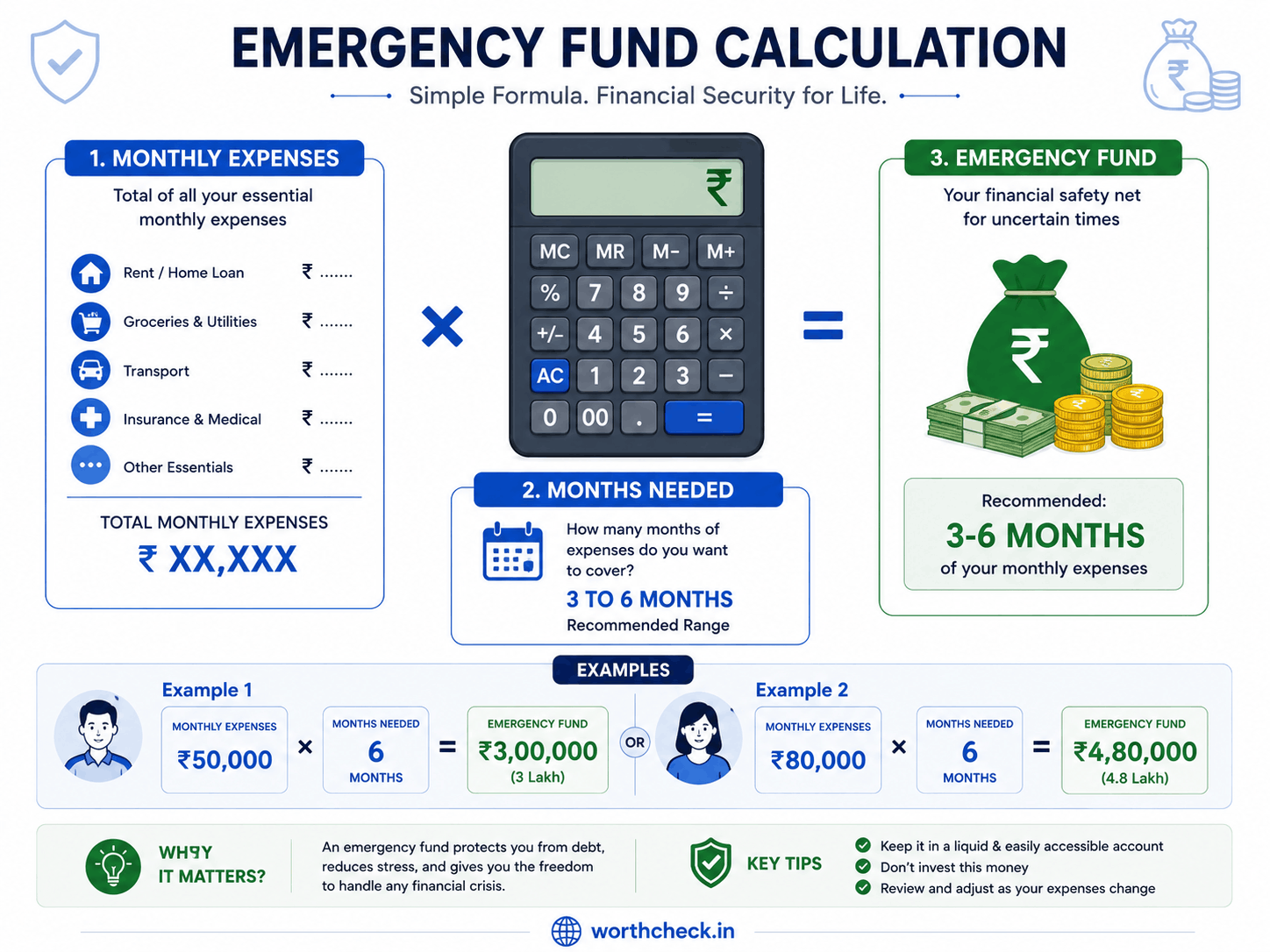
Calculate Your Essential Monthly Expenses:
- Include: Rent/EMI, food & groceries, utilities (electricity, water, gas), insurance premiums, loan EMIs, school fees, medicines, basic transport
- Exclude: Eating out, subscriptions, shopping, vacations, entertainment
- Your emergency fund = Essential monthly expenses × Months needed
Emergency Fund by Salary Level (India 2026)
Here's a quick reference assuming you spend about 60-70% of your salary on essentials:
Rs 50,000 Salary
- Essential expenses: ~Rs 30-35K/month
- 3 months: Rs 90K - Rs 1.05L
- 6 months: Rs 1.8L - Rs 2.1L
- Target: Rs 2-2.5 Lakh
Rs 75,000 Salary
- Essential expenses: ~Rs 45-50K/month
- 3 months: Rs 1.35L - Rs 1.5L
- 6 months: Rs 2.7L - Rs 3L
- Target: Rs 3-3.5 Lakh
Rs 1,00,000 Salary
- Essential expenses: ~Rs 60-70K/month
- 3 months: Rs 1.8L - Rs 2.1L
- 6 months: Rs 3.6L - Rs 4.2L
- Target: Rs 4-5 Lakh
Rs 1,50,000 Salary
- Essential expenses: ~Rs 80-100K/month
- 3 months: Rs 2.4L - Rs 3L
- 6 months: Rs 4.8L - Rs 6L
- Target: Rs 5-7 Lakh
Note:Higher earners often have higher fixed costs (bigger home, car EMI, private school). Calculate YOUR actual essentials, don't just use these benchmarks.
Where to Keep Your Emergency Fund
The biggest mistake people make: keeping everything in a regular savings account earning 3-3.5%. That's losing money to inflation.
The second biggest mistake: putting it all in FDs or liquid funds without instant access. What if the emergency happens at night?
The solution: A tiered approach.
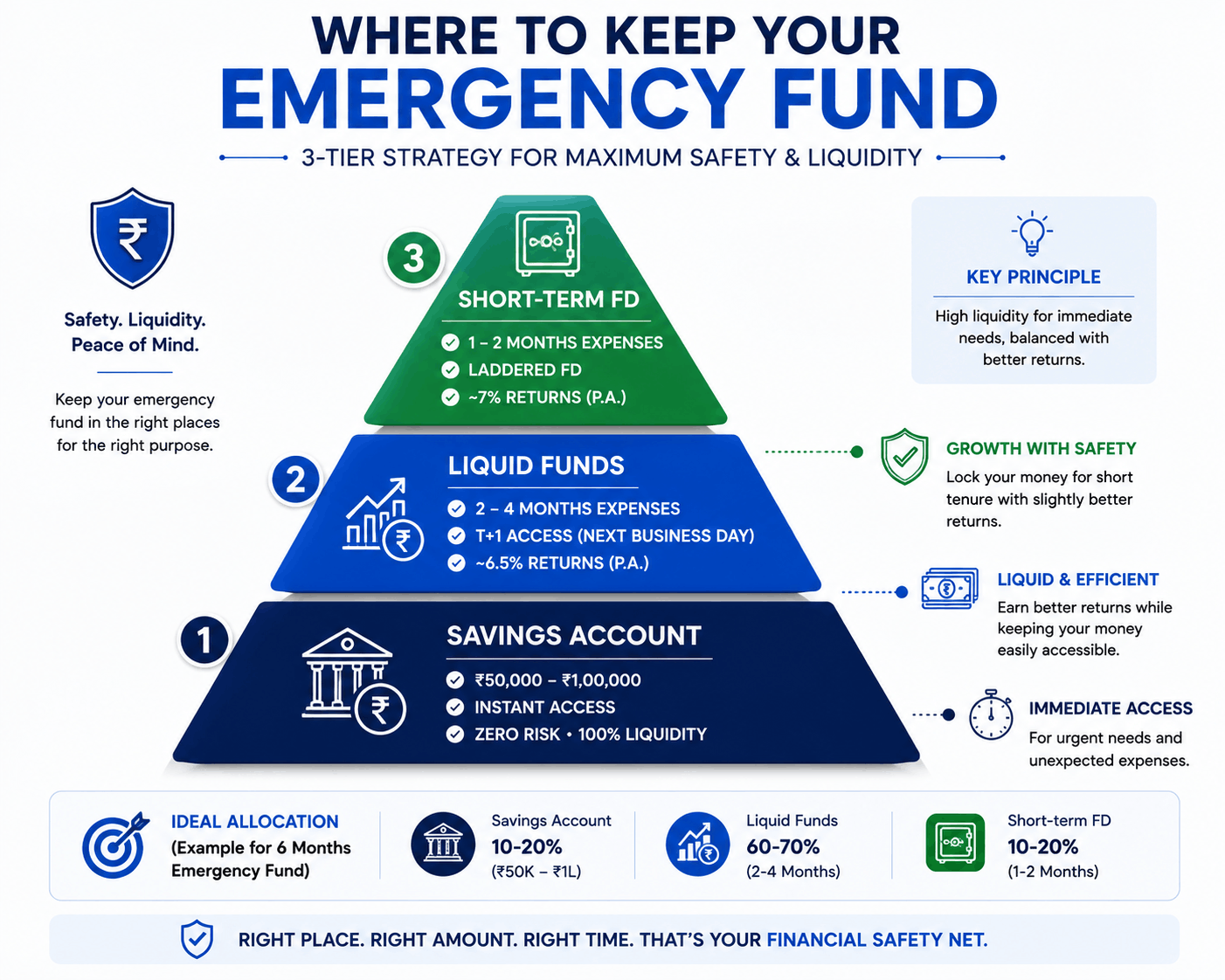
Tier 1: Savings Account (1-2 months)
Amount: Rs 50K - Rs 1.5L depending on expenses
Returns: 3-4% (basic) or 6-7% (high-yield like Kotak, IndusInd)
Access: Instant (ATM, UPI, NetBanking)
Use for: Immediate emergencies, unexpected bills
Tier 2: Liquid Mutual Funds (3-4 months)
Amount: Rs 1.5L - Rs 5L depending on expenses
Returns: 6.5-7.5% (2026 rates)
Access: T+1 day (some offer instant up to Rs 50K)
Use for: Job loss, extended medical treatment
Tier 3 (Optional): Short-Term FD Ladder (1-2 months)
Amount: Rs 50K - Rs 1L in 3-6 month FDs
Returns: 6.5-7.5%
Access: Same day with premature withdrawal penalty (~0.5-1%)
Use for: Last resort backup, rarely touched
Why Not Just Keep Everything in Savings Account?
At 3.5% interest with 6% inflation, your Rs 5 lakh emergency fund loses Rs 12,500 in purchasing power every year. In liquid funds at 6.5%, you're at least keeping pace with inflation. Over 5 years, the difference is Rs 75,000+.
Liquid Funds for Emergency Fund: 2026 Guide
Liquid funds invest in very short-term debt instruments (treasury bills, commercial paper, certificates of deposit). They're designed for parking money safely while earning more than a savings account.
Top Liquid Funds (Returns as of March 2026):
Why Liquid Funds Work for Emergency Fund:
- ✓ No lock-in period
- ✓ T+1 day redemption (instant up to Rs 50K in some)
- ✓ Very low risk (invest in AAA-rated papers)
- ✓ 6-7% returns vs 3.5% savings account
- ✓ Tax-efficient if held >3 years (indexation)
Potential Risks (Low but Real):
- ⚠ Not guaranteed like bank FD
- ⚠ Can have negative returns in rare cases
- ⚠ Credit risk if fund invests in lower-rated papers
- ⚠ Exit load of 0.007% if withdrawn within 7 days
- ⚠ Not accessible instantly (T+1 for full amount)
Pro tip: Choose liquid funds from large AMCs (HDFC, ICICI, SBI, Axis, Kotak) with 10,000+ crore AUM. Stick to Direct plans — avoid the 0.3-0.5% commission on Regular plans.
How to Build Your Emergency Fund Fast (12-Month Plan)
Building a Rs 3-6 lakh emergency fund feels impossible when you're living paycheck to paycheck. But it's absolutely doable with the right approach.
Calculate your target number
List essential monthly expenses. Multiply by 6. That's your goal. Write it down somewhere you see daily.
Start with Rs 1,000
Yes, even Rs 1,000 counts. Open a separate savings account (or liquid fund) ONLY for emergency fund. Don't mix with regular savings.
Automate 10-20% of salary
Set up auto-transfer to emergency account on salary day. Treat it like an EMI — non-negotiable. 10% if tight, 20% if possible.
Add windfalls aggressively
Bonus? Tax refund? Cashback? Wedding gift? Put at least 50% into emergency fund until you hit your target.
Cut one unnecessary expense
Cancel that unused gym membership (Rs 3,000/month). Skip Zomato Gold (Rs 1,500/month). Reduce OTT to one subscription (Rs 500/month). Redirect to emergency fund.
12-Month Build Plan Example (Rs 75K Salary, Rs 3L Target):
- Monthly savings (15%): Rs 11,250 × 12 = Rs 1,35,000
- Annual bonus (50%): ~Rs 37,500 × 50% = Rs 18,750
- Tax refund: ~Rs 15,000
- Cutting subscriptions: Rs 2,000/month × 12 = Rs 24,000
- Selling unused items: Rs 5,000
- Total in 12 months: Rs 1,97,750
- Continue for 18 months to hit Rs 3L target
7 Emergency Fund Mistakes That Will Cost You
1. Investing before building emergency fund
You start SIP, then job loss happens. You sell at 30% loss to survive. Should have built emergency fund FIRST.
2. Keeping everything in regular savings (3.5%)
Inflation is 6%. Your emergency fund loses purchasing power every year. Split into savings + liquid funds.
3. Putting it all in FDs with lock-in
Emergency happens, you pay 1% penalty to break FD. Or worse, 5-year tax saver FD that you can't touch. Emergency fund must be accessible.
4. Using it for non-emergencies
"Diwali sale is emergency!" No, it's not. "Friend's startup needs money." Not your emergency. Protect this fund fiercely.
5. Not adjusting for lifestyle inflation
Built Rs 2L fund 3 years ago. Now expenses are Rs 80K/month. That's only 2.5 months coverage. Review annually.
6. Mixing with regular savings
Emergency fund in the same account as vacation savings. You "borrow" from it. Suddenly, no emergency fund. Keep it separate.
7. Relying on credit cards as emergency fund
"I have Rs 5L credit limit." At 42% APR? That's not a fund, that's a debt trap waiting to happen.
When Should You Use Your Emergency Fund?
Before dipping into your emergency fund, ask yourself three questions:
The 3-Question Test:
- 1Is it unexpected? Did you plan for this expense? If yes (like annual insurance premium), it's not an emergency.
- 2Is it urgent? Must it be paid right now? Can you wait a month and budget for it?
- 3Is it necessary? Will not paying affect your health, safety, or income? If it's "want" not "need", it's not an emergency.
All three must be YES to use emergency fund.
USE Emergency Fund For:
- ✓ Job loss (while searching for new job)
- ✓ Medical emergency (hospital bills, surgery)
- ✓ Major car repair (accident, engine failure)
- ✓ Urgent home repair (pipe burst, roof leak)
- ✓ Emergency travel (family death/illness)
- ✓ Unexpected legal fees
DON'T USE Emergency Fund For:
- ✗ Sale discount ("but it's 50% off!")
- ✗ Friend's wedding gift
- ✗ Vacation ("I deserve it")
- ✗ Phone upgrade
- ✗ Investment "opportunity"
- ✗ Helping others (unless truly life-threatening)
How to Rebuild After Using Emergency Fund
You used your emergency fund. Good — that's what it's for. Now rebuild it BEFORE resuming other investments.
The Rebuild Protocol:
- 1. Pause discretionary spending: No eating out, no shopping, no subscriptions beyond basics until fund is 50% rebuilt.
- 2. Pause non-emergency investments: Stop SIPs temporarily. Redirect to emergency fund. Yes, this feels wrong. Do it anyway.
- 3. Increase savings rate: Aim for 30%+ of income until emergency fund is full again.
- 4. Sell unused items: Old phone, unused gym equipment, clothes you don't wear. Every bit helps.
- 5. Take on side income: Freelance, consulting, weekend work. All extra income goes to emergency fund.
Target timeline: Rebuild 50% in 3 months, 100% in 6-9 months. Only then resume normal investing.
Final Verdict: Build It Before Everything Else
An emergency fund is not sexy. It doesn't give you 15% returns. It doesn't make you rich.
What it does: lets you sleep at night. Lets you negotiate salary without desperation. Lets you wait for the right job instead of taking any job. Lets you handle medical emergencies without breaking investments.
The priority order for your money:
- 1Emergency fund (3-6 months)
- 2Health insurance (if employer doesn't cover)
- 3Term insurance (if you have dependents)
- 4High-interest debt payoff
- 5Investments (SIP, EPF, NPS, etc.)
Most people do #5 before #1. Then wonder why they're always stressed about money.
Build your emergency fund first. Everything else becomes easier after that.
Calculate Your Emergency Fund
Find out exactly how much you need based on your expenses
Frequently Asked Questions
1. Should I build emergency fund before paying off loans?
Build at least 1-2 months emergency fund first. Then focus on high-interest loans (>12% like credit cards, personal loans). Continue building emergency fund alongside low-interest loans (home loan at 8-9%).
2. Is 3 months enough or should I aim for 12 months?
Start with 3 months (better than zero). Build to 6 months (sweet spot for most). Go to 9-12 months only if you're freelancer, single-income family with dependents, or in unstable industry like startups.
3. Are liquid funds safe for emergency fund?
Very safe, but not 100% risk-free like bank deposit. Stick to large AMCs with high AUM (Rs 10,000+ crore). Avoid funds with credit risk (investing in lower-rated papers). Check portfolio on fund website.
4. Should I include EMIs in emergency fund calculation?
Yes, include all EMIs (home loan, car loan, personal loan). If you lose income, these still need to be paid. Missing EMIs hurts credit score and can lead to asset seizure.
5. What if both spouse work? Do we need 6 months each?
If both incomes are stable and independent, 4-5 months of combined expenses is reasonable. If both work in same industry or company, maintain full 6 months — both could be affected by same layoffs.
6. Can I use FD as emergency fund?
Partially. FDs have premature withdrawal penalty (0.5-1%). Don't lock entire emergency fund in FDs. Better approach: 1-2 months in savings, 3-4 months in liquid funds, 1-2 months in short-term FD ladder (3-month, 6-month FDs).
7. Should I invest emergency fund in equity or debt?
Never equity. Emergency fund is not for growth — it's for safety. Stock market can drop 30% exactly when you need the money (like March 2020). Keep in savings, liquid funds, or short-term FDs only.
8. I have health insurance. Do I still need emergency fund for medical?
Yes. Insurance doesn't cover everything (OPD, deductibles, non-network hospitals, treatments not in policy). Also, there's time gap between hospital bill and insurance claim settlement. You need cash upfront.
Related Articles
FIRE Movement India Guide
Achieve financial independence and retire early
SavingsHow Much Should You Save by Age 30?
Benchmarks for Indian millennials
RetirementNPS vs EPF vs PPF Comparison
Choose the right retirement savings
InvestmentSIP vs Lumpsum: Which Strategy Wins?
Data-driven investment comparison
Written by
Sid Joshi
Founder, WorthCheck.in